Chapter One
Three Days in the Dark
By seven in the morning, the Sterling family estate in the Hamptons was already buzzing with quiet activity. In the gleaming marble kitchen, the staff worked in hushed tones; outside, the automated sprinklers nourished the pristine gardens; and on the third floor, behind a heavy mahogany door with polished brass fixtures, Elena lay perfectly still in her bed, one hand protectively cradling her seven-month-pregnant stomach.
It wasn’t exhaustion. It wasn’t a sudden illness.
It was utter, suffocating terror.
She had not stepped foot out of that bed for three entire days.
At first, the household brushed it off as the moody whims of a difficult pregnancy. Then, they whispered that she was staging a dramatic act to win back her busy husband’s attention. But when Julian Sterling — one of the East Coast’s most ruthless venture capitalists — started to show signs of frustration, the rumors turned malicious.
“She’s covering something up,” his sister, Victoria, murmured in the grand foyer, a cruel smirk playing on her lips. “No normal woman isolates herself like that without a guilty conscience.”
Julian caught the end of that sentence from his study. He remained silent, but a muscle feathered in his jaw.
He was a man who despised the unknown.
He had conquered the financial world by thirty, executing hostile takeovers without blinking an eye. But ever since Elena had barricaded herself in their suite, his control was slipping.
His wife refused to meet his gaze.
Whenever he stepped into the room, she pulled the heavy silk duvet tight against her chin.
Whenever he demanded to know what was wrong, she would merely croak, “Please, Julian… just give me some space today.”
And it was tearing his mind apart.
Elena wasn’t always a ghost of a woman. When they first married, she was vibrant — a passionate rare-book archivist working in a small city library. She possessed no trust fund, no pedigree.
When Julian brought her home, his mother, Beatrice, welcomed her with a frosty, aristocratic smile that dripped with condescension.
“Let us hope you can adapt to the expectations of this family,” she had remarked on their very first evening.
Over the next two years, Elena silently absorbed the veiled insults and polite humiliations. Julian, always on a jet closing his next multi-million-dollar acquisition, assumed she was seamlessly blending into their world of opulence. He remained entirely oblivious as his family systematically suffocated his wife’s spirit.
And now, carrying his heir, she seemed to have completely given up.
This morning, Julian took the stairs with a cold, calculated fury. He gripped his smartphone tightly, the screen lit up with a grainy photograph Victoria had texted him two nights prior.
The picture showed the shadowy outline of a man slipping out the estate’s side gate at two in the morning. The caption beneath it felt like a knife twist: “I hate to break this to you, Julian… but it seems Elena is making a fool out of you.”
The poison had fully taken hold.
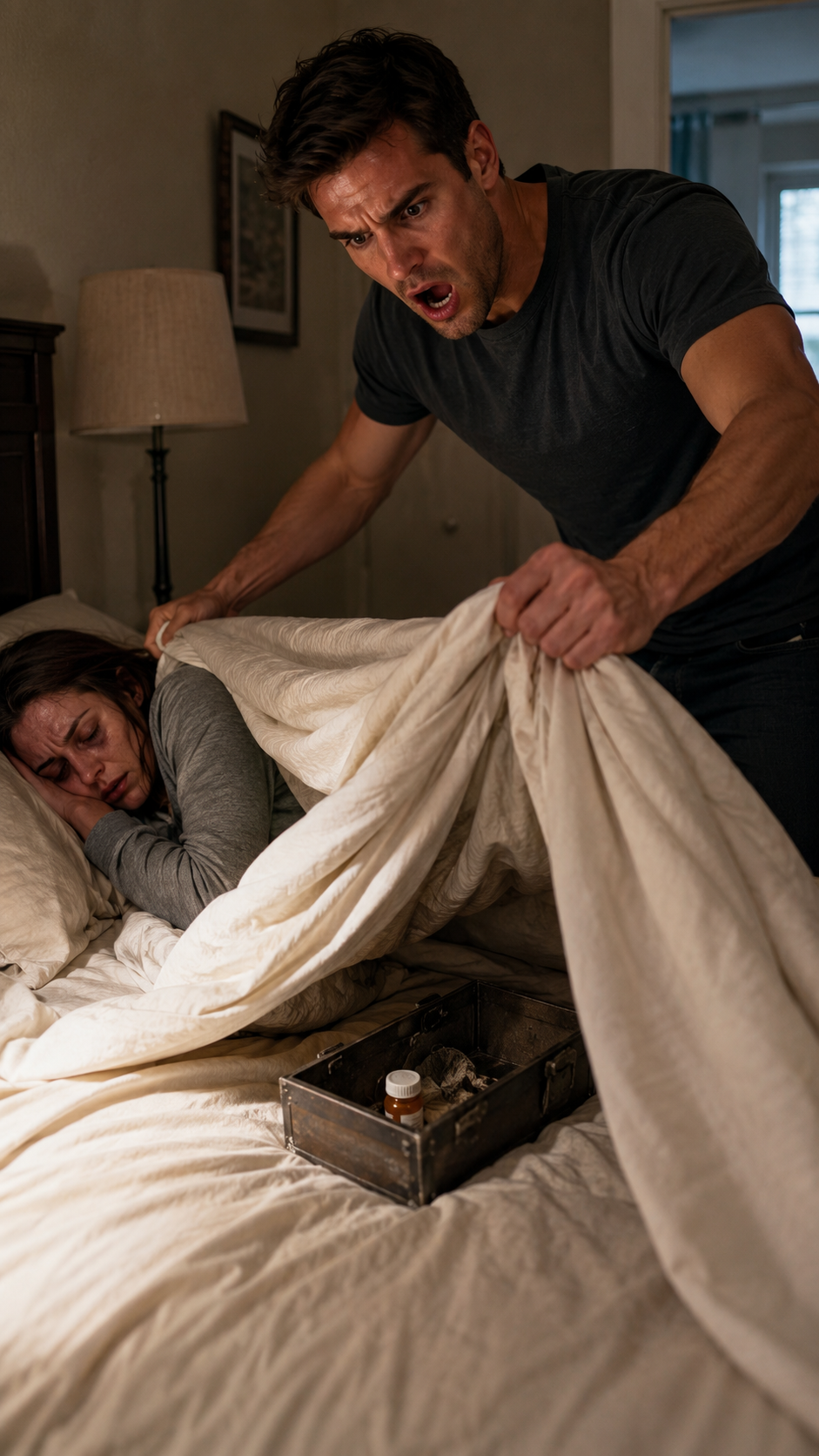
Without knocking, he shoved the bedroom door wide open.
Elena was curled in a fetal position beneath the massive duvet. Her skin was ashen, her eyes wide with a frantic, hunted look — a look Julian immediately misinterpreted as the panic of a cheating wife.
“Get out of that bed,” he commanded.
“I can’t,” she whimpered, her throat clicking as she swallowed.
“Who was the man in the picture Victoria sent? Are you seeing someone else?”
Elena squeezed her eyes shut with infinite weariness.
“Julian… please don’t do this… if I show you, nothing will ever be the same.”
“Nothing is the same anyway!” he bellowed, his ego shattered.
He lunged for the edge of the duvet. Elena scrambled to hold onto it with what little strength she had left.
“No… please, no…”
But Julian was too strong, ripping the thick blanket away with one furious pull.
What he laid eyes on sucked all the oxygen from his lungs.
He could not comprehend what was about to unfold.
Chapter Two
What Was Under the Blanket
There was no man’s cologne on the sheets. No second pillow dented by another head. No lace, no lipstick, no evidence of the affair Julian had spent two sleepless nights rehearsing in his mind.
There was a thin white monitoring belt strapped around Elena’s swollen stomach, three wired sensor pads pressed against her skin, and a portable fetal monitor no bigger than a paperback book, its small screen blinking a soft green light. Beside her pillow, half-hidden under a second blanket she’d shoved there in panic, sat a folder thick with printed lab results, an ultrasound envelope, and a business card for a Manhattan maternal-fetal medicine practice Julian had never heard of.
He stood frozen, the duvet still balled in his fist, his fury draining out of him so fast it left him lightheaded.
“Elena.” His voice had lost its edge entirely. “What is this?”
She didn’t answer right away. She was crying now, silently, the kind of crying that comes from someone who has been holding a single breath for far too long and has finally been allowed to let it go.
“Placental complication,” she finally said. “Dr. Webb found it six weeks ago. If I’m not monitored properly, if I go into labor without warning, I could lose the baby. I could lose more than the baby.”
Julian’s knees found the edge of the mattress before he decided to sit. “Six weeks. You’ve known for six weeks and you said nothing?”
“I tried to tell Dr. Reyes.” Her voice cracked on the name. “Your mother’s doctor. The one she insisted I switch to the week we found out I was pregnant. He looked at my chart for four minutes and told me I was being an anxious first-time mother. He told me the same thing three separate times, Julian, while the numbers on my labs kept getting worse.”
“So you found someone else.”
“I found someone else at two in the morning, because that was the only time Dr. Webb could see me without your mother’s staff noticing the car in the driveway. I made him park at the side gate. I told him not to use his real name with the guards.” She finally looked up at him, and what was in her eyes wasn’t guilt. It was exhaustion, and something colder underneath it. “That’s the man in Victoria’s photograph, Julian. That’s who you’ve spent two days convinced was destroying our marriage.”
Chapter Three
The Memo She Wasn’t Supposed to Find
She told him the rest in pieces, because it had happened to her in pieces, each one small enough on its own to doubt, until they’d stacked into something she could no longer explain away.
Three months earlier, Elena had gone looking for a spare printer cartridge in Beatrice’s study and found, instead, a memo she was never meant to see — a letter from the Sterling family’s estate attorney, addressed to Beatrice directly, discussing what it called “contingency planning around Julian’s marriage prior to the child’s birth.”
The language was careful, lawyerly, bloodless. But underneath the careful language, the meaning was plain. If Elena’s pregnancy could be documented as medically complicated — if there were concerns, on record, about her capacity to make sound decisions under the stress of a high-risk pregnancy — a postnuptial agreement Julian had signed years ago, quietly, before he’d ever met Elena, contained a clause that could be triggered. A clause that would place the child’s trust, and a controlling share of decisions around it, under Beatrice’s guardianship rather than Elena’s, “in the event of the mother’s demonstrated medical or psychological incapacity.”
Elena had read it twice, then a third time, sitting on the floor of a study that wasn’t hers, in a house that had never once felt like home.
“I didn’t understand it fully until Dr. Reyes started brushing off my symptoms,” she told Julian now. “He wasn’t a bad doctor, Julian. He was a convenient one. Every visit where he wrote ‘no cause for concern’ on my chart was one more piece of paper that made me look stable, calm, fine — right up until the day I wasn’t, and by then it would be too late for anyone to argue with the medical record your mother’s attorney had spent months building.”
Julian sat very still, the folder of lab results open on his lap, doing arithmetic he didn’t want to finish. “You thought if you told me, I’d side with her.”
“I thought if I told you, you’d need proof. And every piece of proof I had came from a doctor your mother chose.” Elena wiped her face with the back of her hand, steadier now that the worst of it was finally out of her. “So I found my own doctor. And I kept quiet until I had enough to make it impossible for anyone to call me an anxious, incapable woman making things up.”
Chapter Four
The Doctor Who Said Nothing Was Wrong
Dr. Webb’s records told the story Dr. Reyes’s file had been built to hide.
Across six weeks of visits, Elena’s placental readings had moved steadily in the wrong direction — the kind of pattern that, in any properly managed pregnancy, would have triggered increased monitoring, a modified activity plan, and a clear protocol for early delivery if the numbers crossed a defined threshold. Dr. Webb’s notes were blunt where Dr. Reyes’s had been vague: elevated risk, patient correctly identified her own symptoms, patient’s concerns were valid and should have been escalated weeks earlier.
Julian called Reyes’s office from the bedroom, Elena watching from the bed, and got exactly the kind of answer he now expected. The receptionist informed him, politely, that Dr. Reyes’s practice was retained directly through the Sterling Family Office — through Beatrice’s office, not Julian’s, not Elena’s — and that any change in care would need to go through the family’s usual channels.
“There is no ‘usual channel,'” Julian said, quietly enough that Elena flinched at how much quieter his fury had become than his shouting ever was. “There’s my wife, and there’s my child, and there’s a doctor who spent six weeks telling her she was fine while she wasn’t.”
He hung up before the receptionist could answer.
For the first time in three days, he looked at his wife the way he should have been looking at her all along — not for evidence of betrayal, but for what was actually written on her face. Fear. Calculation. The particular exhaustion of someone who has been fighting a war entirely alone because she wasn’t sure anyone would believe there was one.
“Why didn’t you just leave,” he asked, and it wasn’t an accusation. It was the question of a man realizing, slowly, how much easier that would have been for her, and how much it must have cost her not to.
“Because leaving meant leaving with nothing proven,” Elena said. “And a woman with nothing proven, against a family with your mother’s lawyers, doesn’t get to keep her own child. I wasn’t protecting a marriage, Julian. I was building a case. I just never thought I’d have to build it against your family instead of with them.”
Chapter Five
The Man at the Side Gate
Victoria’s photograph, it turned out, hadn’t been an accident.
Julian pulled the estate’s own security footage — the same cameras that fed the same system Beatrice’s household staff monitored around the clock — and found the full sequence Victoria had cropped down to a single damning frame. Dr. Webb arriving at 1:52 a.m. carrying a medical bag clearly marked with a clinic logo. Dr. Webb leaving forty minutes later, glancing at his phone, checking the time the way a man checks the time when he has an early surgery, not the way a man checks the time when he’s sneaking out of an affair.
Victoria hadn’t just seen a stranger at the gate. She had watched the full, unremarkable footage of a doctor’s house call, and chosen the one frame that could be twisted into a scandal — then sent it to her brother with a caption designed to detonate exactly what it detonated.
“You knew,” Julian said, when he found his sister in the solarium an hour later, his phone held up with the full, uncropped footage playing on the screen. “You knew exactly who that was.”
Victoria’s composure slipped for less than a second before she rebuilt it. “I knew a strange man was sneaking around this house at two in the morning while my brother was traveling. Forgive me for thinking that mattered.”
“You didn’t think it mattered. You thought it was useful.” Julian’s voice was flat now, stripped of the temper that had carried him up the stairs three days earlier. “Useful to Mother’s memo. Useful to a case against Elena’s fitness that’s been building since before this baby had a heartbeat anyone could hear.”
Victoria didn’t deny it. She simply looked at him, weighing, the way she’d been taught to weigh things her whole life — by cost, not by conscience — and said, “Mother only ever wanted to protect this family’s money from someone who married into it with nothing.”
“Mother,” Julian said, “was willing to let my wife go into premature labor unmonitored so a lawyer could write the word ‘incapacity’ on a piece of paper. That’s not protecting this family. That’s what it looks like when the family is the thing that needs to be protected from.”
Chapter Six
The Family Meeting
Beatrice Sterling had built her entire life around never being caught without a prepared answer. She did not have one the evening Julian called a meeting in the very study where Elena had first found the memo, and laid three folders on the desk between them: Dr. Webb’s complete medical record, the security footage in full, and a copy of the attorney’s letter Elena had memorized nearly word for word months before anyone knew she’d read it at all.
“You had six weeks of documentation showing my wife and my child were at real medical risk,” Julian said, “and your response was to keep her tied to a doctor who was protecting a legal strategy instead of a pregnancy. That’s not caution, Mother. That’s a decision you made, on paper, about whose safety mattered less.”
Beatrice’s chin lifted, the old reflex of a woman who had spent forty years winning arguments by refusing to look defeated. “Everything in that letter was contingency planning. Nothing more. Attorneys draft worst-case scenarios; that is their job.”
“Then you won’t mind if I have our attorney draft a worst-case scenario of his own,” Julian said. “One where the postnuptial clause you were counting on gets voided for having been executed under a material misrepresentation of medical facts you had access to and chose not to disclose. One where the Family Office’s control over Dr. Reyes’s contract becomes very relevant to a family court. I imagine your attorney can explain how that kind of contingency tends to play out.”
The room went quiet in the particular way rooms go quiet when the person who has always held the power finally understands, in real time, that they no longer do.
It was Elena, standing in the doorway with one hand resting on the small monitor she now wore without hiding it, who spoke last. “I’m not interested in taking anything from this family, Beatrice. I never was. I only ever wanted my daughter to be born safely, in a house where no one was keeping score of what it would cost you if she was.”
Beatrice looked at her for a long moment — really looked, perhaps for the first time in two years — and said nothing at all, which was, for a woman who had never once been at a loss for words, its own kind of answer.
Chapter Seven
What She Chose to Keep
The baby came six weeks later, three weeks early, in a delivery suite Dr. Webb had personally prepared for exactly the complication his six weeks of careful records had warned about — a fast, controlled delivery that would have been a crisis anywhere Elena hadn’t already fought, alone, to be believed.
They named her Rose, after no one in particular, because Elena wanted at least one thing about her daughter’s life to belong to nobody’s legacy but her own.
The postnuptial clause was formally amended within the month, at Julian’s insistence, stripped of the language that had once made his wife’s health a legal liability instead of simply a fact to be cared for. Dr. Reyes’s contract with the Family Office was quietly not renewed. Victoria kept her place in the family, technically, though she was no longer handed anything she could turn into a weapon. Beatrice never apologized outright — some habits outlast even their usefulness — but she came to the hospital, and she held her granddaughter for a long time before she said, to no one specifically, “She has Elena’s hands.”
Julian carried the folder of lab results with him for months afterward, not because he needed the proof anymore, but because he needed the reminder — of how close he had come to tearing away the wrong thing entirely, and calling it certainty.
Elena went back to her rare books eventually, restoring a nineteenth-century atlas for a Manhattan collector, Rose asleep in a bassinet beside her worktable in a house that finally felt, in small and daily ways, like it was actually hers.
She never wore the fetal monitor’s small green light as a scar. She wore it, when she thought about those three days at all, as proof that she had been the only person in that house who never once stopped protecting her daughter — quietly, alone, and long before anyone else believed there was anything left to protect her from.