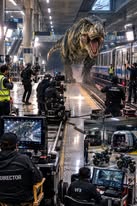

You think you’ve seen every dinosaur sequence Hollywood could possibly cook up. You’ve watched them sprint across open plains, smash through jungle research facilities, and snap jeeps in half. But nothing prepares you for the sheer claustrophobia of a subterranean transit tunnel echoing with guttural, sub-bass vibrations while the camera refuses to cut away.

The Return of Raw Cinematic Suspense
Set against the murky, damp labyrinth of an abandoned metropolitan transit network, the film strips away the glossy, sunlit sheen of standard prehistoric blockbusters and plunges audiences into near-total darkness. From the opening sequence, the focus shifts toward raw creature tension rather than nonstop CGI explosions. It delivers the kind of old-school cinematic dread where every flicker of fluorescent light feels like a countdown to absolute disaster.

Mild spoilers ahead — nothing past the midpoint.

The Darkness Beneath the Tracks
The premise wastes zero time setting up its high-stakes confrontation. A decommissioned subway line undergoing nocturnal surveying becomes ground zero when structural anomalies trigger a catastrophic cave-in. What begins as an emergency rescue mission rapidly spirals when the seismic shifts awaken a dormant apex predator that has made the ancient underground cavern system its territorial lair.
The turning point arrives right at the forty-minute mark. Trapped within a dead-end maintenance terminal, the surviving crew realizes the beast isn’t hunting by sight—it’s navigating entirely through structural vibrations and subway line frequencies. And then… everything changes.
A power grid reboot unexpectedly illuminates three miles of forgotten rails, revealing that the creature isn’t merely wandering aimlessly. It is guarding an ancient breach point that extends directly beneath the city’s heart. But that’s where things get interesting: how does a creature of that magnitude hunt within confines so tight it can barely turn around—and what happens when the emergency exits begin sealing from above?
What Hits the Mark
- Suffocating Atmosphere: Confining a gigantic predator inside narrow railway tunnels turns every corner into a lethal choke point.
- Sound Design: The sound team deserves high praise; low-frequency roars rattling train car windows create legitimate theater-shaking impact.
- Tactile Visuals: The seamless blend of heavy practical sets, water spray, and lighting tricks makes the monster feel genuinely heavy and physically present.
Where It Stumbles
- Thin Side Character Arcs: A few secondary engineers exist solely to make questionable decisions when tension runs high.
- Frenetic Midpoint Pacing: The transition between slow-burn investigative mystery and full-tilt creature chase can feel slightly abrupt.
Standout Moments
Here’s what most people missed during the chaos: during the tension-soaked flooded tunnel sequence, the creature stalks the team completely submerged under stagnant track water, betrayed only by a rising wave and ripples across the surface. It is easily one of the most nerve-wracking single-take suspense sequences staged in creature-feature history.
Final Verdict
If you crave big-screen spectacles that prioritize tension, sound, and genuine environmental peril over mindless spectacle, this is an absolute must-watch in a packed theater. It taps right back into that primal childhood fear of the dark and leaves you glancing nervously at subway grates on your commute home.
What Viewers Are Saying
- Marcus Vance: “That tunnel water scene had my entire row holding their breath. Absolute masterclass in tension.”
- Elena Rios: “The practical set design made all the difference. You could practically smell the damp concrete and rust.”
- Derek Lawson: “Way more intense than recent franchise installments. It actually treated the predator like a monster instead of a superhero.”
- Chloe Bennett: “I jumped three times during the emergency light sequence. Incredible sound mixing!”
- Julian Hayes: “The pacing in the middle was a bit rushed, but the creature design and claustrophobia totally carried it.”
Frequently Asked Questions
Is this connected to any major dinosaur franchise?
No, it is a standalone sci-fi creature thriller that builds its own self-contained world and lore around underground geological anomalies.
Is the film safe for younger kids?
Due to intense sequences of peril, creature violence, and sustained psychological claustrophobia, it is geared toward teens and adults who enjoy intense creature thrillers.
Were practical animatronics used during filming?
Yes, filmmakers built life-sized creature rigs and practical sets to interact with physical dust, water, and lighting before augmenting final passes digitally.