Don’t Look Down: The Franchise Climbs Into Pure Chaos
If you thought dangling 2,000 feet in the air from a rusty radio tower was stressful, brace yourself. Fall 3: Terminal Velocity doesn’t just tap into your latent acrophobia—it grabs you by the throat, pulls you out past the cliff edge, and dares you to look straight down into a dizzying abyss.

Survival cinema often struggles with sequels. How many times can you strand people in mid-air before the premise wears thin? Yet somehow, director Scott Mann’s expanding universe shifts gears from isolated panic into an intense, sprawling alpine nightmare that feels uncomfortably real.

The Ascent Into the Unknown
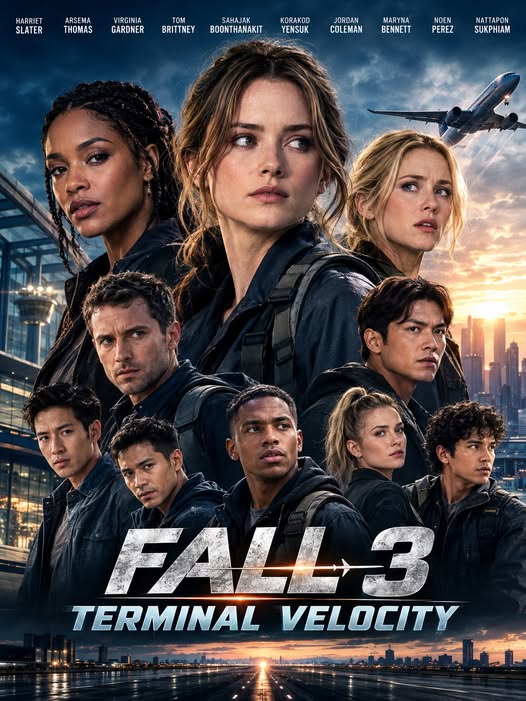
The story kicks off with seasoned survivors crossing paths with an ambitious new expedition tackling an unmapped, razor-thin mountain ridge. Returning veteran faces Tom Brittney and Sahajak Boonthanakit bring an immediate sense of dread—they know what gravity does to human flesh, and their caution contrasts sharply with the fearless confidence of newcomers Harriet Slater and Arsema Thomas.

Slater plays an experienced climber whose technical precision masks recent trauma, while Thomas injects magnetic, relentless fire into a group chasing glory in the absolute worst terrain on Earth. From the first base camp departure, the mountain feels less like a setting and more like an apex predator silently waiting for someone to slip.
Mild spoilers ahead — nothing past the midpoint.
When the Ropes Snap: Plot Breakdown
The initial climb begins with standard high-altitude tensions: thin air, sudden gusts, and frayed tempers. But that’s where things get interesting.
As the team reaches a brutal vertical face known colloquially among climbers as the ‘Drop Zone,’ a freak atmospheric drop unleashes ferocious freezing winds. An anchor point cracks under pressure, forcing the team into a desperate, split-second repositioning maneuver thousands of feet above sea level.
And then… everything changes.
Instead of a standard retreat, the team realizes their descent line has been completely sheared by falling rock. Worse, an attempt to signal base camp uncovers a chilling realization: their distress beacon is dead, and the storm approaching from the north is moving three times faster than forecasted. Stranded on an overhang smaller than a dining table with dwindling carabiners and failing equipment, Harriet Slater and Arsema Thomas must make an agonizing choice—wait for a rescue that might never come, or attempt a terrifying lateral leap across an open crevasse to reach an abandoned auxiliary station.
Here’s what most people missed in the buildup: the mountain isn’t the only threat testing their survival instincts. A fractured radio signal hints that someone else might be on the ridge with them—or deliberately sabotaged their safety lines. But who would risk their life in this frozen graveyard, and why?
Where the Film Soars
- Relentless Vertigo: The camera work is downright sickening in the best possible way. The sheer drop-offs and sweeping drone shots will make your stomach drop into your shoes.
- Commanding Lead Performances: Harriet Slater and Arsema Thomas share electrifying chemistry. Thomas brings fierce bravado, while Slater grounds every terrifying scene with raw vulnerability.
- Tactical Tension: Unlike thrillers that rely on dumb character choices, the crew makes logical, smart decisions under pressure—making the escalating catastrophes hit twice as hard.
Where It Loses Its Grip
- Occasional CGI Seams: While the practical stunts look breathtaking, a few wide digital backgrounds during the blizzard sequence look slightly weightless.
- Familiar Survival Tropes: You will recognize some classic survival movie beats—the frayed rope strand, the dropping water flask, and the ticking-clock storm.
Standout Moments That Will Freeze Your Blood
Without giving away the second half, the sequence where Thomas’s character must hang entirely by one arm while swinging across a sheer rock chimney to free a jammed cam will leave fingernail marks in your armrests. It is an absolute masterclass in sound design and heart-pounding physical suspense.
The Verdict: Pure White-Knuckle Adrenaline
Fall 3: Terminal Velocity proves there is still terrifying power left in high-altitude horror. Anchored by two powerhouse female performances and relentless pacing, it delivers every ounce of dread and exhilaration survival junkies crave. Just remember to breathe.
What Viewers Are Saying
- Marcus Vance: “My watch recorded a 115 bpm heart rate during the chimney jump. Absolutely insane tension!”
- Chloe Jenkins: “Arsema Thomas and Harriet Slater are an incredible duo. Best entry since the original!”
- Devon Miller: “I literally had to pause the movie twice to unclench my hands. Do not watch if you hate heights.”
- Sasha Kowalski: “The mystery surrounding the snapped safety line kept me guessing the entire time.”
- Liam Bennett: “Visceral, terrifying, and surprisingly emotional. A wild thrill ride from start to midpoint.”
Frequently Asked Questions
Do I need to watch the previous Fall movies before watching this one?
Not necessarily. While returning cast members add extra depth for franchise fans, this film establishes its characters, stakes, and deadly survival scenario completely on its own.
Is Fall 3: Terminal Velocity based on a true story?
No, it is a fictional survival thriller, though many climbing techniques, gear failures, and environmental hazards are modeled after real mountaineering emergencies.
How intense are the heights and vertigo scenes?
Extremely intense. Viewers with acrophobia or severe vertigo should prepare for prolonged wide angles, steep drop-offs, and dizzying high-altitude camera movements throughout the film.