
I Thought It Was Just Another School Thriller… Until the Silence Started Feeling Loud
At first glance, it looks like a familiar high school mystery. Strict rules, quiet hallways, students hiding things behind polite smiles. Nothing new, right?

But Teach You a Lesson (2026) doesn’t take long to prove otherwise. Somewhere between the whispers in the corridors and the pressure behind every bowing student, the story starts to feel uncomfortably real… and deeply personal.

And then—everything shifts.

Why This Drama Hits So Hard
A School Built on Secrets
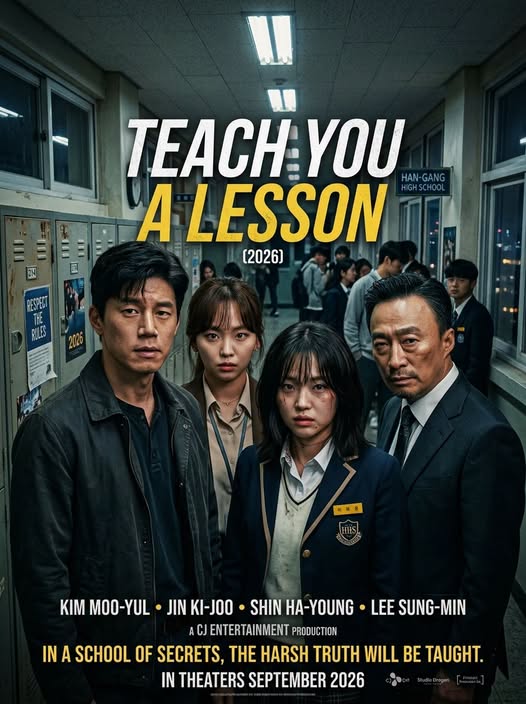
Han-Gang High School isn’t just a setting. It feels like a system—carefully controlled, polished on the surface, but rotting underneath. A single incident cracks that illusion wide open, and what spills out is chaos disguised as order.
What makes it unsettling is how believable it all feels. The fear of speaking up. The pressure to stay silent. The cost of being “the problem student.”
When Truth Becomes Dangerous
A determined teacher steps into the center of the storm, not realizing how deep the corruption runs. A troubled student holds fragments of truth no one wants to hear. And the authority figures? They’re not just hiding things—they’re protecting an entire system built on silence.
But here’s what most people miss… the real danger isn’t the secret itself. It’s what happens when someone finally tries to expose it.
The Characters You Can’t Forget
Kim Moo-yul’s Quiet Intensity
There’s a controlled rage in his performance. Not loud, not explosive—just constantly burning underneath. You can feel his frustration growing with every unanswered question.
Jin Ki-joo Between Duty and Conscience
Her character feels like someone constantly standing at a moral crossroads. Every decision costs her something. And that internal conflict becomes one of the emotional anchors of the story.
Shin Ha-young’s Haunting Presence
She doesn’t just play a student. She plays a wound the system refuses to acknowledge. Every glance feels heavy with things unsaid.
Lee Sung-min’s Commanding Authority
He doesn’t raise his voice often—and he doesn’t need to. His silence alone feels like control. Cold, calculated, and terrifyingly calm.
Strengths
- Emotionally layered storytelling that builds tension slowly but effectively
- Strong performances that feel grounded and human
- A realistic portrayal of institutional pressure and silence
- Psychological suspense that keeps tightening with every episode
Weaknesses
- Slow-burn pacing may not suit viewers expecting fast twists
- Some supporting characters feel intentionally distant, which can reduce emotional connection at times
Standout Moments
There are scenes that don’t rely on action—but on silence. A hallway conversation that lasts too long. A pause before answering a question. A look exchanged between characters that says more than dialogue ever could.
And then… there’s the incident reveal. Not because it’s loud, but because it feels inevitable. Like the truth was always waiting there.
A Drama That Lingers After It Ends
Teach You a Lesson (2026) isn’t just about uncovering a mystery. It’s about what it costs to uncover it.
It stays with you—not because of shocking twists, but because of how familiar its silence feels. The kind of silence you recognize even if you’ve never lived in Han-Gang High School.
And when it ends, you don’t feel relief. You feel reflection.
What Viewers Are Saying
- Daniel Brooks: “I didn’t expect a school drama to hit this deep. I was wrong.”
- Sophie Martin: “Every episode felt heavier than the last… I couldn’t stop watching.”
- James Carter: “The silence in this show is louder than most action scenes.”
- Emily Johnson: “That reveal didn’t shock me… it hurt me.”
- Ryan Lee: “Lee Sung-min is terrifying in the calmest way possible.”
- Hannah Kim: “I kept thinking about my own school days while watching this.”
- Mark Thompson: “This isn’t entertainment. It’s emotional pressure.”
- Ava Wilson: “The performances carried everything. Absolutely unforgettable.”
- Lucas Brown: “It doesn’t scream at you—it slowly breaks you.”
Frequently Asked Questions
Is Teach You a Lesson (2026) based on a true story?
No official confirmation, but its realism makes it feel painfully authentic and grounded in real-world issues.
Is it more mystery or emotional drama?
It balances both, but the emotional and psychological drama is what truly defines it.
Is the pacing slow?
Yes, it’s a slow-burn thriller. But every moment builds tension rather than wasting time.
Does it have a satisfying ending?
It’s more reflective than explosive. The ending prioritizes emotional truth over neat closure.
Is it worth watching for thriller fans?
Absolutely—especially if you enjoy character-driven mysteries with psychological depth.